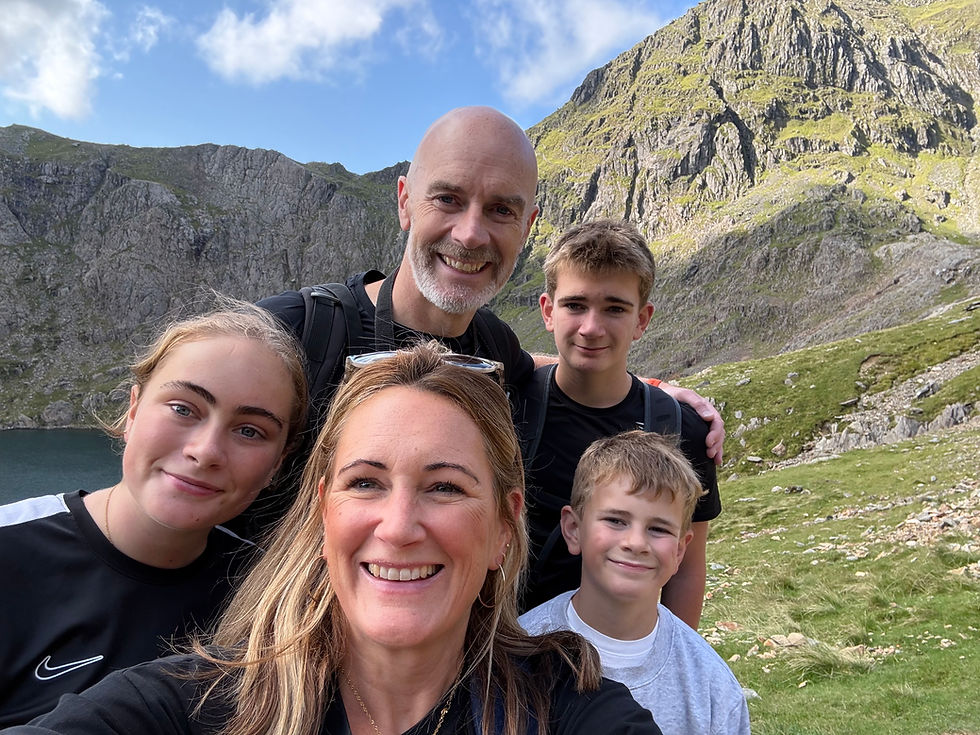
Deany's Story: "To be honest, I was petrified to close my eyes in case I never woke up."
Sunday evening, around 9pm. I was relaxing at home with my husband, watching a documentary on telly. Suddenly, I felt this almighty, terrible pain in the back of my head. As the pain got worse, I just knew something was wrong.

It was 2020 and I was 48, a social worker in Wigan. With three grown children and three dogs, life was a lovely routine of work, long, wooded walks and travelling with my husband. I didn’t know it then, but after that night, my life would never be the same.
The pain was all consuming. Lying down on the couch, I said to my husband, ‘You need to get an ambulance.’
Over the phone, they asked all sorts of questions related to strokes, about my face, whether I could move my arms, or look at bright light. And as my vision faded and I started to be sick, I was praying to God for some kind of relief from the pain.
Three and a half hours later, I was finally picked up to be taken to hospital, where, after hours on the ward, I had a CT scan. That’s when they found the bleed in my brain. At 7am the following morning, an ambulance arrived to take me to Salford Royal. I remember asking the paramedics, ‘Am I going to die?’. But no one would give me an answer.
Then, I had an angiogram – a tube is inserted through the groin carrying contrasting dye, which can help show clinicians the source of the bleed. They told me I had a ‘birthmark’ – a weakening in a vessel in my brain that had likely been there my whole life which finally burst. But, this one had also stopped bleeding on its own, which was good news.
Despite this, my time in hospital was horrific. As it was 2020, during COVID, I was all alone for another two weeks – no family or friends were able to see me. The entire time I had to remain lying flat, so they could see if there were any other issues.
I don’t remember ever sleeping. To be honest, I was petrified to close my eyes in case I never woke up. I was so scared of what was happening, what had happened. That I might die.
But eventually, I was allowed to get up and walk around. I remember going to the toilet for the first time and looking at myself in the mirror. There was this waxy, grey-coloured woman staring back. Although I knew it was me, it was shocking – I didn’t recognise myself.
Even though the pain was still so unbearable, I was finally allowed to go home. My friends and family were all in shock. I was only 48 and the haemorrhage had come with no warning signs.
Although all I’d wanted lying there in hospital was to go home, it was, in some ways, the beginning of a more difficult journey. As fantastic as my family and friends are, it felt like I had nobody to talk to. Nobody could understand what I was going through. It felt like everyone was thinking, ‘You’re home, you're going to be all right now. Let's just move on.’
The beginning of my recovery marked many hard changes in my life. The doctors told me that over the next three years, my brain would do the healing it was able to. I wasn't allowed to drink, no caffeine. Stress or any other things on my mind make it difficult to absorb new information. So reading, which I love to do, has been mostly impossible since my haemorrhage.
A few months later, I was struggling at work. It felt, at times, like what dementia might be like. I couldn’t recognise people and my memory simply wasn’t functioning well enough to do my job. Realising I could no longer be a social worker, a career I loved, was heartbreaking.
The trauma of the event itself, the fact that I was awake throughout all of it, has also taken its toll. For a long while, I couldn’t bear to hear an ambulance pass by. Small, confined spaces and planes are still extremely frightening for me.
Today, I’m in therapy, which helps me to sift through the trauma of what happened. To look at me, you might see a ‘normal’ woman. But the person I was before is no longer there. I sometimes feel guilty – for being lucky enough to have survived when so many don’t. But the grief of losing so much of myself is sometimes hard to deal with.
But – I can live with it. I'm very grateful that I'm still here – and these days, I don’t save anything for ‘best’. You know how you have a ‘best’ handbag – the one you keep upstairs, only for special occasions? Now I think every day is a special occasion – I don’t wait to do things.
And I’ve realised how important it is to raise awareness and educate people, because I knew nearly nothing about brain haemorrhages before this happened to me.
Recognising the signs, asking questions about pain levels, acting quickly – these can be critical to whether someone survives and how they recover. That’s why I’m planning to leave a gift in my Will to The Natalie Kate Moss Trust. One day, all of our efforts could save lives and prevent others from going through the same experience as me.