
‘I’m not well. I need to get home.’
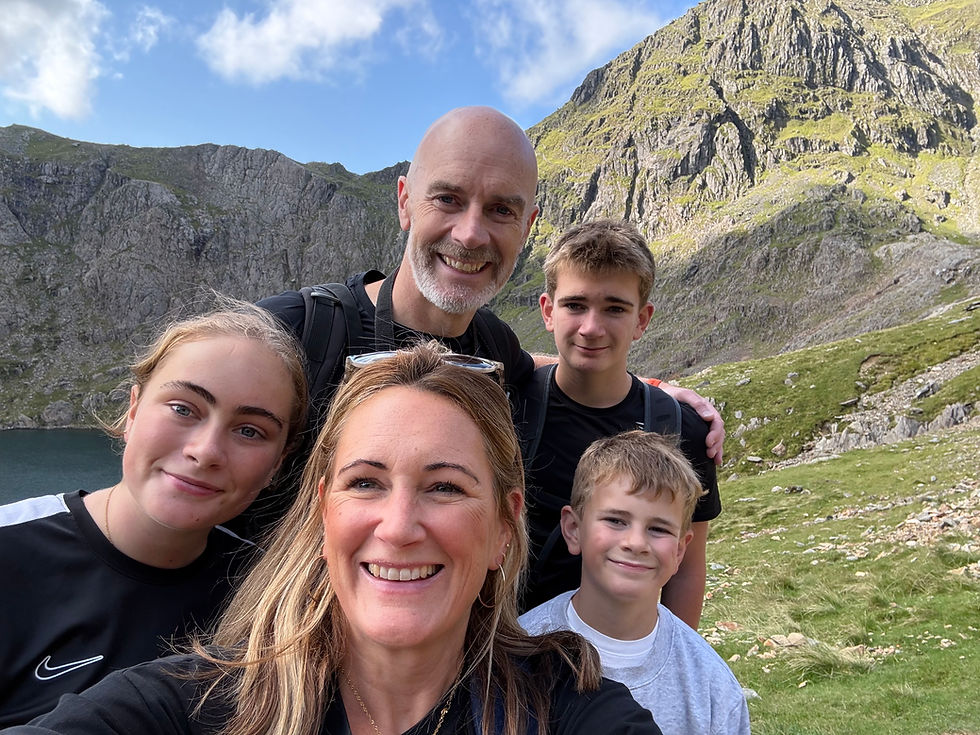
These are the words my husband Dom said when he rang me as he was leaving the gym. But his speech was slightly slurred. He just didn’t sound like Dom. He wasn’t making sense.
I told him to pull over, that I’d come get him and the kids, but he insisted. If you know anything about Dom, he never gets ill. He just pushes through – he’s driven and ambitious. Fit and healthy.
When he got home, he was struggling to get out of the car. My brain went immediately to ‘stroke’. Dom was quite adamant that if he just had a lie down, he would be ok. But after managing to get up the stairs and into bed, he was just lying there in the fetal position. I guess my instinct just kicked in.
First, I tried 111, but in hindsight it was lucky I couldn’t get through. I remember putting the phone down, pacing, watching him get worse. So I called an ambulance – and it escalated quickly from there. When they arrived, they took his stats and it was an irregular heart pattern that made them act. He told them his pain was a 7 out of 10, but when we got to the hospital, he couldn’t talk. He was wearing a hoodie that he pulled over his eyes – the lights were simply too much.
It was a passing consultant who saw the state Dom was in. When he said his pain was now a 10, they took him straight away for a scan. I sat there, with the little rucksack I’d packed and within minutes, they came to tell me it was a brain haemorrhage.
From there he was blue lighted to Salford Royal – a specialist Stroke Unit. I just remember a lovely nurse bringing me a tea with lots of sugar because I was in a whole world of shock. At that point, nobody really explained what was happening – in an emergency you get the headlines: just ‘It’s a brain hemorrhage and we're going to take him for another scan’.
One part of my brain was thinking about the kids – what on earth am I going to tell them? The other part was thinking, ‘Oh God, is this it? Is he dying?’. I rang my best friend and I remember saying, so vividly, ‘I can't do this.’
But when we were at Salford, everything sort of slowed and became strangely peaceful. They had to put him in a completely black room and made sure he was horizontal. They were lots of tests, another CT scan, he had cannulas on and they pumping him with goodness knows what.
While deciding whether they might operate, they told me to go home for the night. You know when people say they didn’t sleep a wink? That was me. I got up early, went across the road, where my kids were staying with a friend, gave them cuddles. Then I tried to reach the hospital. They told me Dom was stable. I felt my knees go from under me.
In the end, they decided not to operate. Instead, it was just bed rest and pain relief. He couldn’t sit up, eat, drink. But the doctors told me this was normal – this would be the process.
Dom was in hospital for nine days, always in so much pain. It’s strange because you can't see anything – no cuts, nothing physical that shows what’s happened to Dom. But everything has changed. Driving him home, was like driving home with a newborn; it was the beginning of the rest of our lives.
His fatigue was enormous. For a long time, Dom would walk into rooms without a clue what he was doing. In conversations, you could see his brain just shut off. Loud, busy rooms are still incredibly difficult; he struggles to go to a match and have a pint with his mates. Dealing with three kids, who are full of energy and questions, is an ongoing challenge. But mostly, it's been tough watching someone who’s always been confident, active, loves what he does, just find everything hard work.
When we left the hospital, we didn’t really know up from down. Today Dom has a support group, which has made a huge difference to his recovery. We have to live alongside the brain haemorrhage, because it will always be there. But every day, we remind ourselves that we’re the lucky ones. Dom is still here.
I have two wishes for people who find themselves in the unimaginable place a brain haemorrhage brings to your world. One is that for those lucky enough to leave hospital, that they have the information and support they need to make the best of a terrible situation. I found The Natalie Kate Moss Trust when I was desperately seeking to make sense of what was happening – and there were so few resources available to us when Dom came home.
The other is that we can, together, do something that makes the future brighter for the thousands of others who will experience a brain haemorrhage. By supporting this research, we can actively change lives. It was so important that Dom got the care and support he needed quickly – I know it’s made a huge difference to his recovery.


